
TrainYourEars EQ Edition is an ear training software for Mac and PC designed to help you understand equalisers and frequencies like never before.

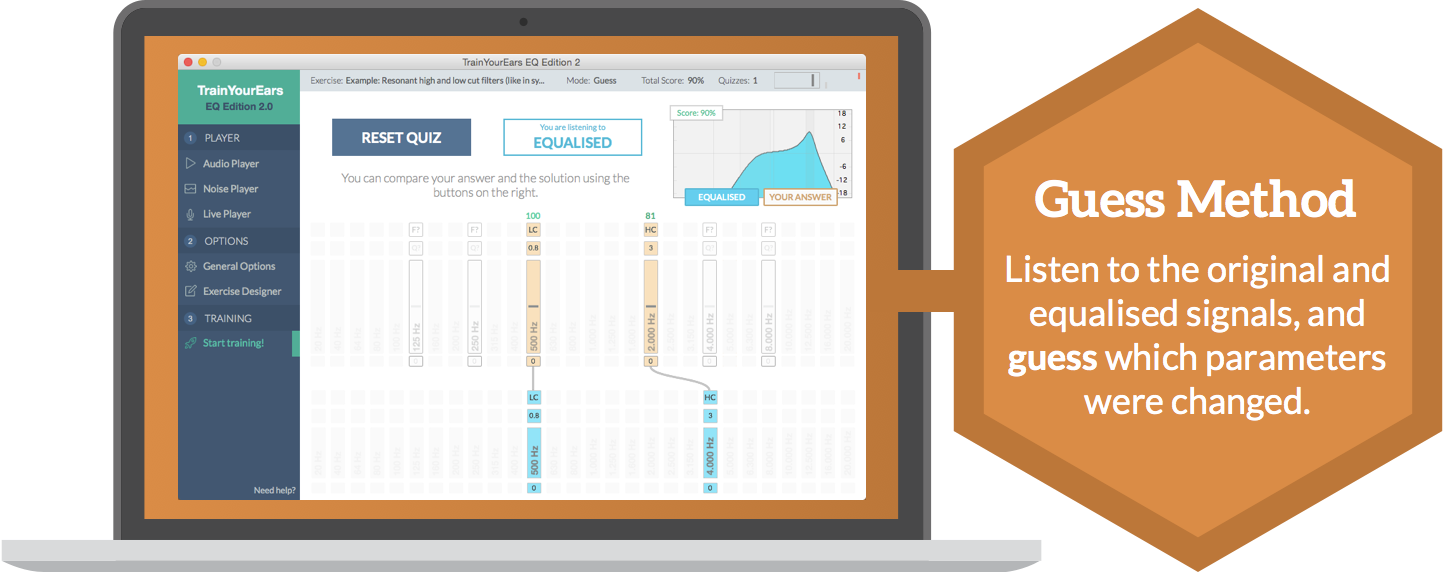
It speeds up your learning process exposing you to hundreds of random equalizations you have to guess. If you are wrong, it will let you know “how wrong”, and it will let you hear both your guess and the correct answer.
In no time you will develop a frequency memory which will allow you to connect the sound you imagine in your head with the parameters you need to dial, quickly and easily than ever.

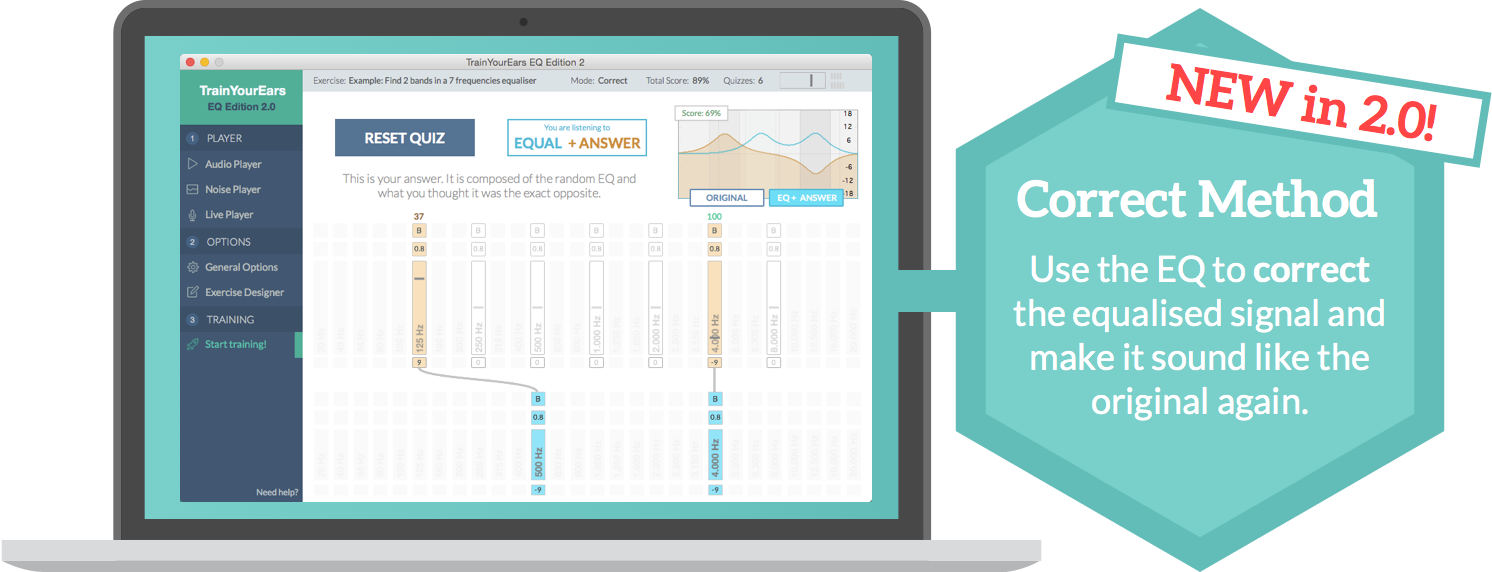
It has a brand new training method. Instead of guessing, you have to make corrections while you hear the result.
The person who suggested this method to us in the first place was Bob Katz, a renowned mastering guru. We tested it, we loved it, so here it is for all you to enjoy!
Besides it has a new, modern and clean interface, a new assisted training screen, a new exercise designer, it supports other languages, and many other features.
The ability to connect what is in your mind with the appropriate parameters you have to dial to get that sound is not an easy task. The steps involved should be:
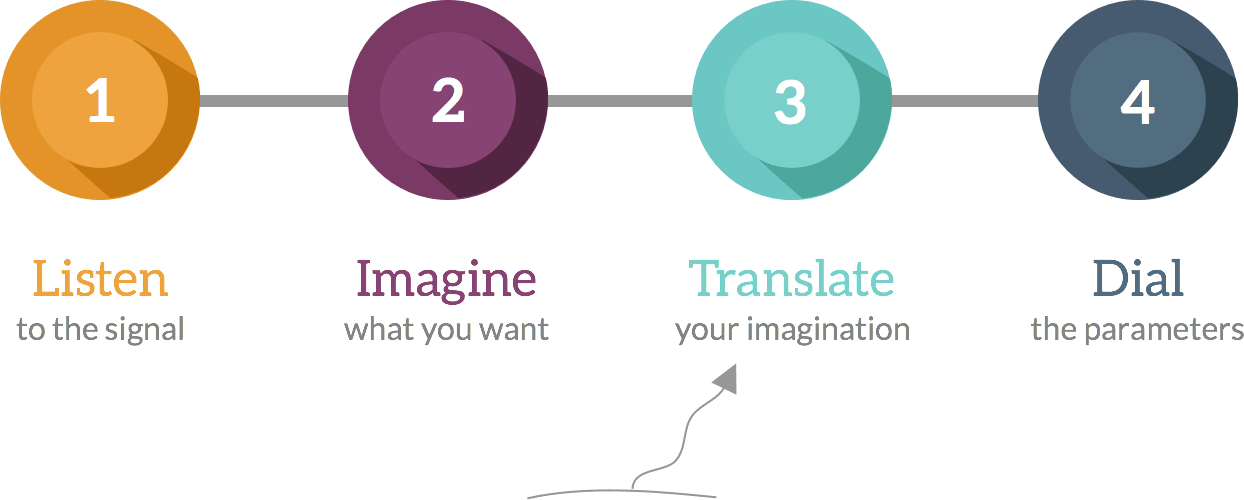
Sometimes people get lost in the translation step and start turning knobs without confidence. The more you work, the better you understand what those knobs really do, but it is a slow process.
People excel in this matter after many years, because they have learned experimenting with lots of different processes applied to lots of different sources. The purpose of this training is to open your ears to what each frequency sounds like and reduce the amount of time needed to acquire this knowledge.
In 15 minutes you can guess or correct 100 random equalisations, so training every day for a few weeks is equivalent to accumulating the experience of many years.
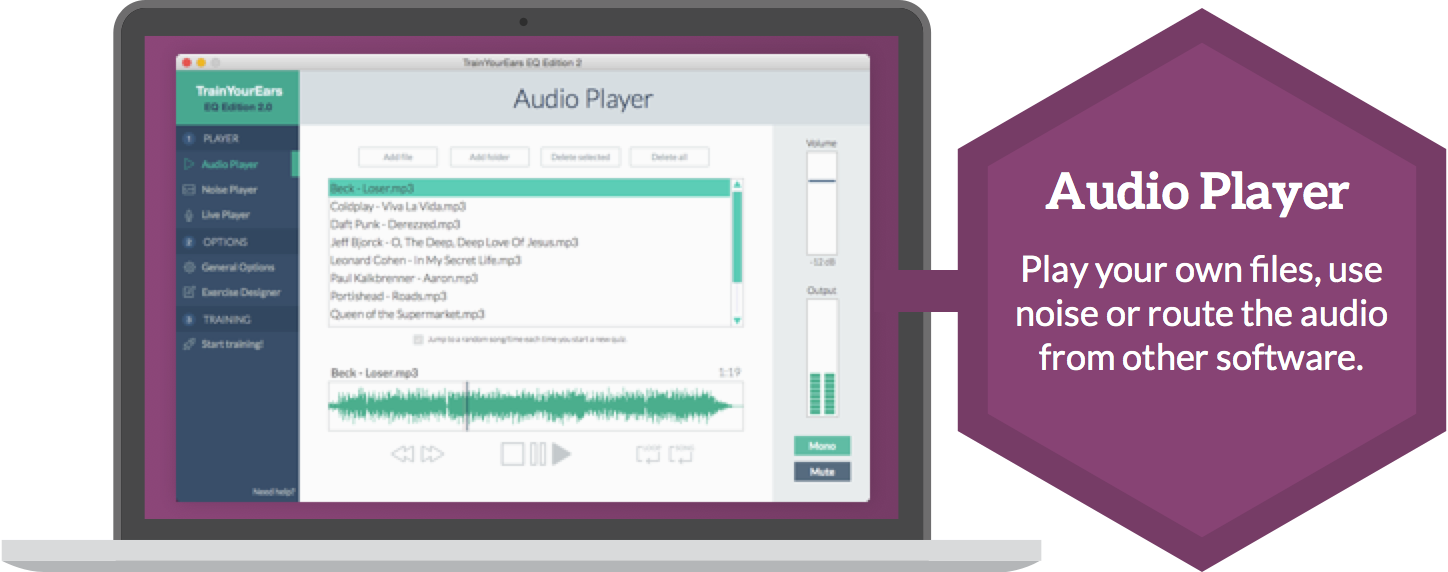
First, you load the music you want to train with:
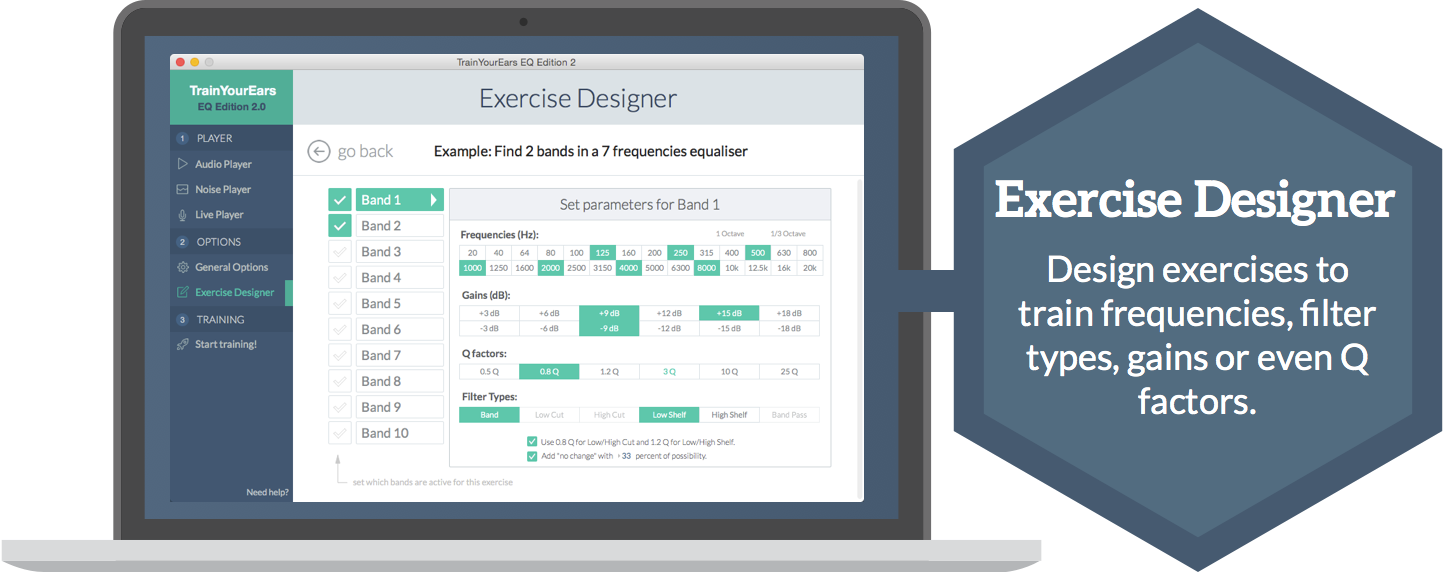
Then, you choose an exercise or design a new one:
And finally, train your ears with one of these two methods!
Wanna see more?
There’s an ambiguity here that’s telling. Are these “current email addresses” the public-facing lifelines of firms adapting to remote workflows? Or are they evidence of informality—companies using free, widely accessible accounts rather than corporate domains? The implication is twofold: on one hand, a pragmatic embrace of tools that reduce friction and cross borders; on the other, a sign that branding and control over identity on the web have loosened in an age when speed matters more than polish.
Japan, often imagined as a place of meticulous signage and carefully curated corporate façades, appears in this fragment as improvising. Startups and small firms, or individuals acting as proxies for businesses, may rely on free providers because setting up a domain-based email is perceived as unnecessary overhead. There’s also a democratic element: a small business owner in Sapporo or a maker in Osaka can attach their enterprise to an international inbox and, in doing so, claim access to the global marketplace without waiting for institutional gatekeeping.
In the morning inbox of 2022, a curious chorus of addresses sings the story of globalization’s quiet aftermath. The phrase—“2022 current email addresses of companies in Japan gmail com hotmail com yahoomail com aol net”—reads less like a request for data and more like a fragmentary poem about how companies and culture meet on the plain stage of the internet. There’s an ambiguity here that’s telling
Finally, there’s a human story behind each address. Every gmail.com or hotmail.com linked to a company represents hours of negotiation, shipment confirmations, and the tiny rituals of business life: invoices sent at midnight, apologies for delayed replies, congratulatory messages after a successful collaboration. The domain is just the envelope; the conversation inside it remains unmistakably human.
Those domain snippets—gmail.com, hotmail.com, yahoomail.com, aol.net—are relics and lingua franca. They are mass-market mail carriers born in different eras of the web: Gmail the efficient, modern archivist; Hotmail the 1990s migrant now reborn under new banners; Yahoo Mail the nostalgic portal that once promised everything; AOL the dial-up memory that still clings to an identity. To list them after “companies in Japan” suggests a collision: formal Japanese corporate life, steeped in tradition and hierarchy, reaching outward through platforms made for personal use and global convenience. The implication is twofold: on one hand, a
In short, this compact string captures a moment where local industry and global infrastructure intertwine—where tradition meets the pragmatic tools of a connected world. It’s a small, telling fingerprint of how commerce lived online in 2022: improvised, porous, and quietly cosmopolitan.
Linguistically, the line reads like a scraped search query: stripped of grammar, heavy with keywords. That form mirrors how we now seek knowledge—fast, modular, and algorithm-ready. The lack of punctuation or capitalization accelerates the phrase into a stream of metadata: date, attribute, place, and service providers. It’s modern shorthand, the language of data scouts and list compilers, as comfortable in a spreadsheet as on a forum. There’s also a democratic element: a small business
Yet there’s a tension worth noting. When companies use personal or generic email domains for official correspondence, questions of trust and legitimacy surface. Recipients may suspect scams; partners may hesitate. In cross-border commerce, an email from a branded domain signals investment and permanence. An address ending in gmail.com or yahoo.com, conversely, suggests impermanence—or nimbleness, depending on who’s judging.
People are loving ♥ TrainYourEars.
Wanna see more?
READ MORE TESTIMONIALSFinal price was 89€, but the 49€ launch offer was such a success that we sold twice as many as we expected.
After a lot of thought we decided to keep this reduced price forever :)
Thanks to all the people who has supported this project so far and made this possible!




Trusted by thousands of students and teachers from the world’s top universities.