

Polaris is a music-making app that lets you produce electronic music right from your phone or tablet. Whether you're an experienced musician or a complete beginner, you'll feel right at home using it.
new update released
Polaris is an intuitive musical sketch pad tailored for phones and tablets so you can capture your ideas on the go. The design philosophy is simple: provide the essentials in an accessible, but powerful format to get ideas down whenever and wherever inspiration strikes. The end result is a music production app that allows you to skip the complicated learning curve of traditional Digital Audio Workstations (DAWs) so you can get to the fun part sooner.
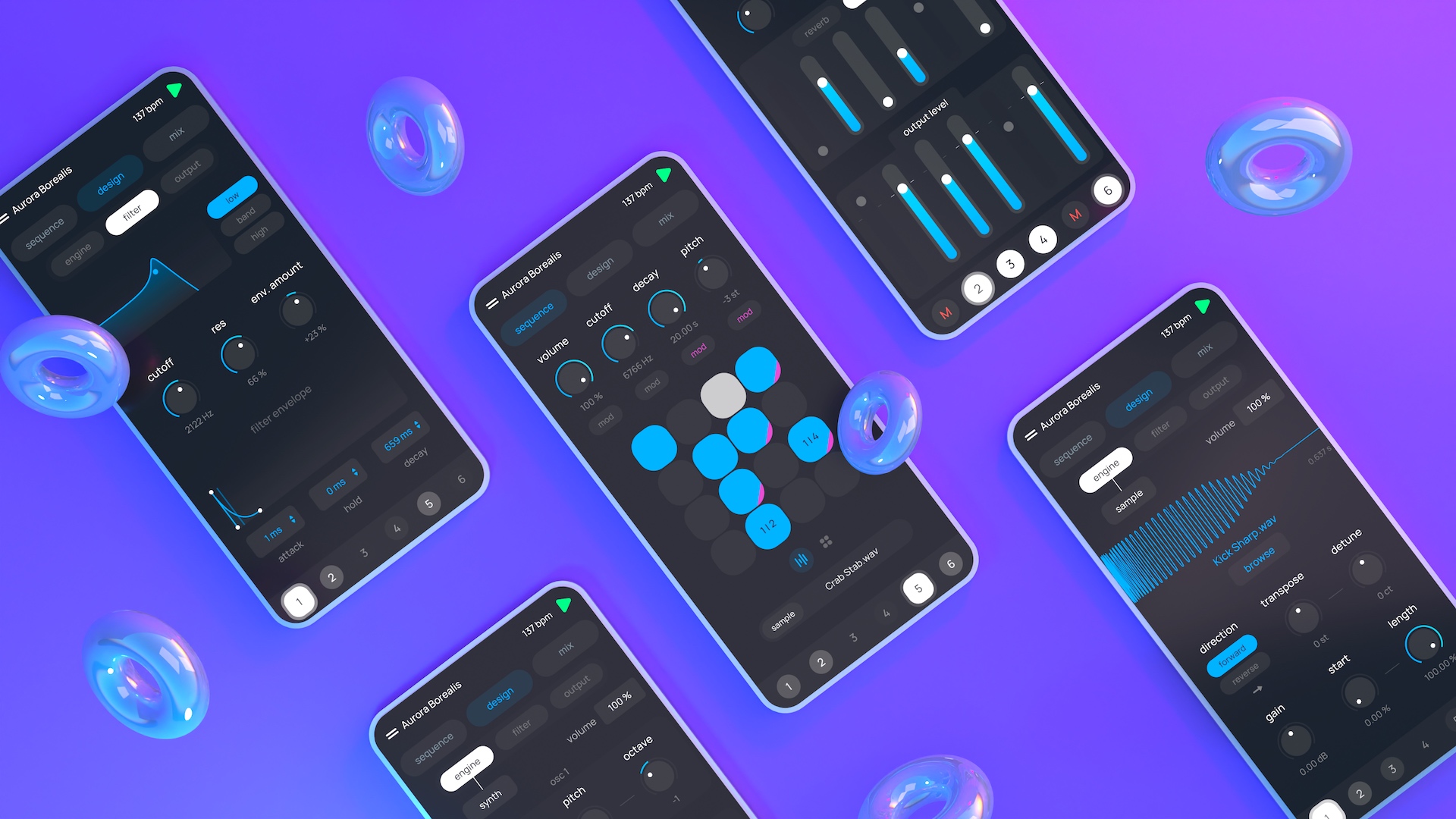
Export your patterns as audio files with the built-in recorder. From short loops to longer performances, your recordings are ready to use in any music app, desktop software, or in Polaris itself. When recording, everything is captured in real time meaning that you get every knob twist, step edit, and seamless switch between projects. This results in perfectly cut, ready-to-use loops with no extra editing required.

The sequencing logic in Polaris was inspired from modern drum machines and grooveboxes. Simply press a step on the 4x4 grid to start your creative journey. Create sequences on up to six tracks to combine their different sounds.
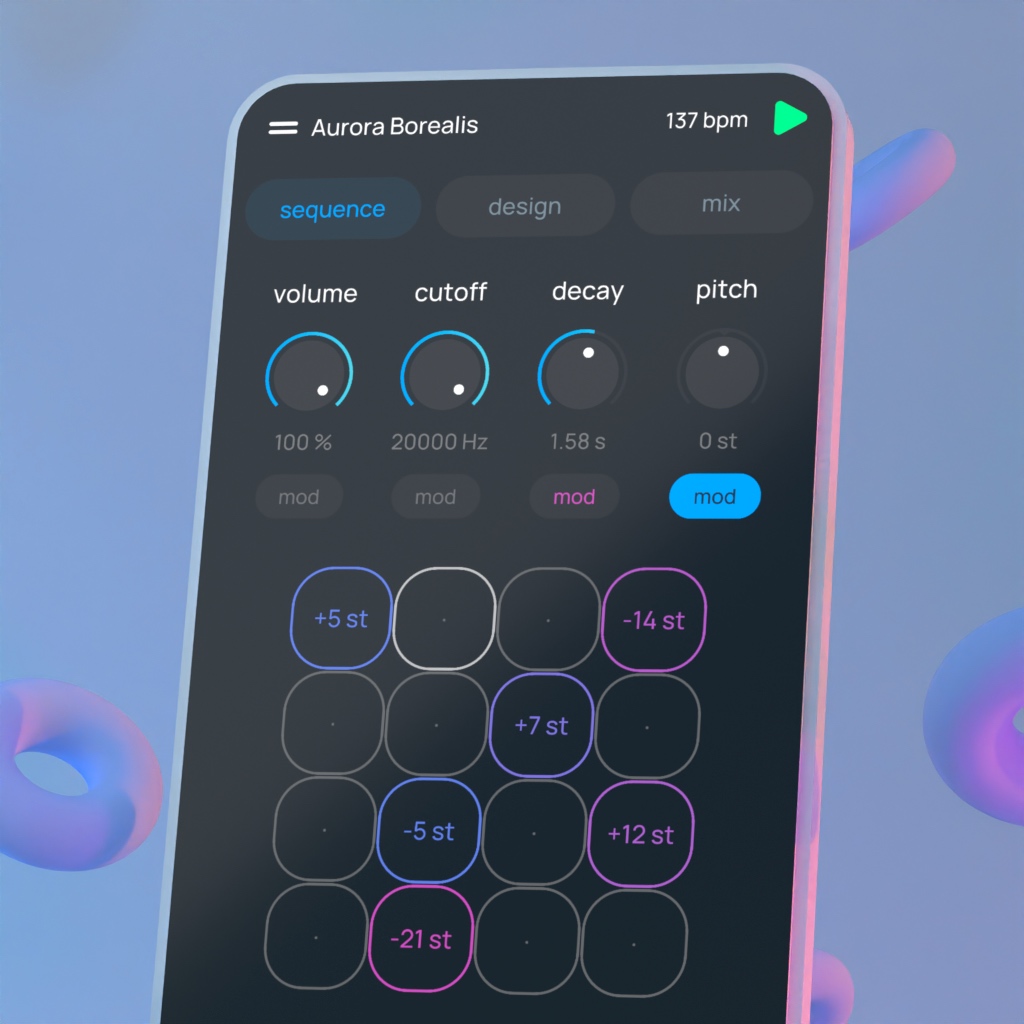
Step modulation allows you to create complex variations within seconds. Easily alter your volume, cutoff, decay, and pitch by dragging the values higher or lower.
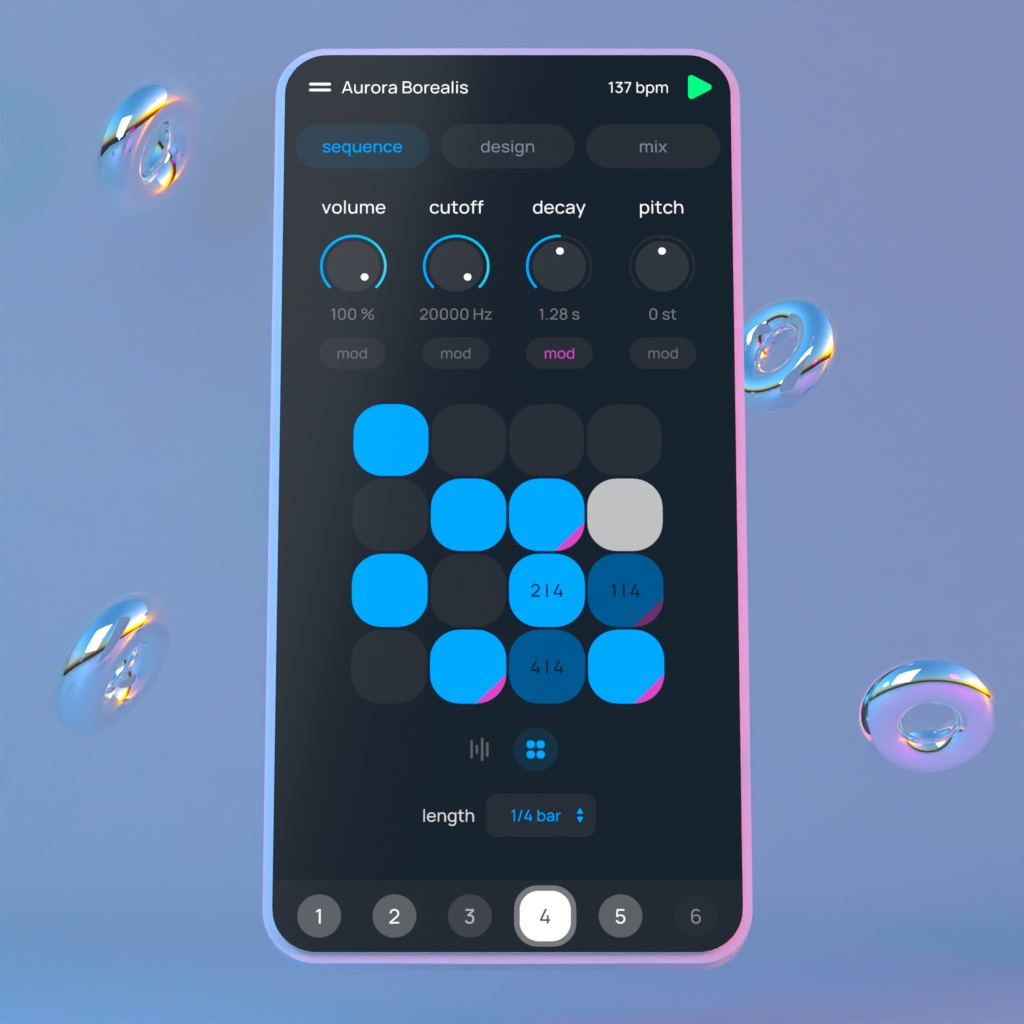
Seamlessly chain up to eight grids or bounce between patterns on the fly to keep the inspiration flowing. Each track runs at its own pace: from a chill cruise with a full bar per step to a lightning-fast 1/32 bar speed. Plus, trig conditions keep your grooves fresh by allowing you to trigger notes every two or four loops.
One of the perks of electronic music production is the variety of sounds you can experiment with. Get started with Polaris' meticulously curated sample bank, which should keep you busy for a while. Want to do it your way? Load your own samples directly into the app for limitless sonic exploration.
For even more variety, try the synth engine, featuring a dual-oscillator architecture.
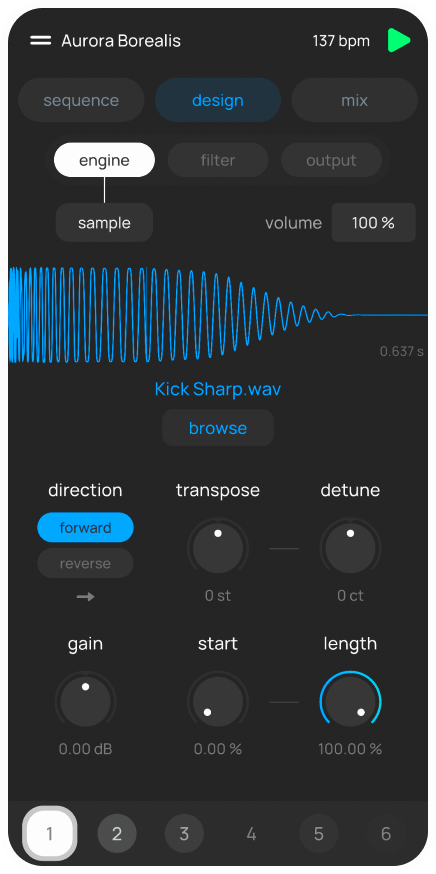
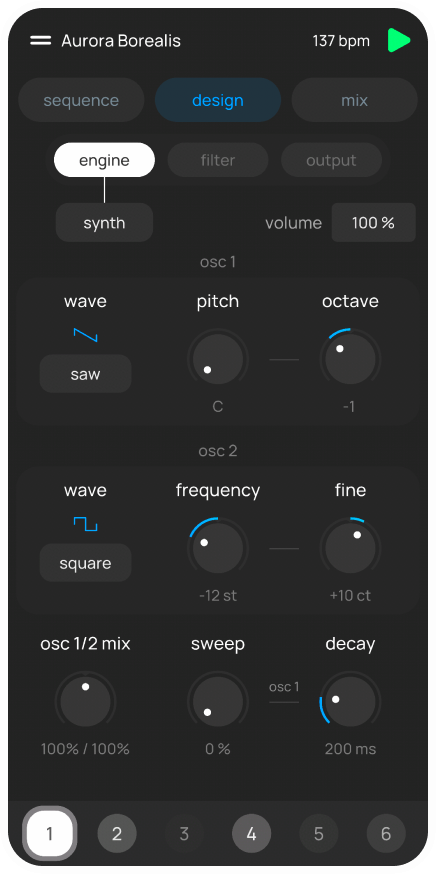
The sample and synth sound engines should cover most of your needs, from creating lush pads and deep rumbling basslines to bright plucky notes and sharp drum hits.
In addition, each track includes a multimode filter so you can sculpt your frequencies however you want, while the built-in distortion module can give you a little extra punch.
After crafting the perfect combination of sounds and sequences for your project, use mixing tweaks to magnify and fine tune your pattern.
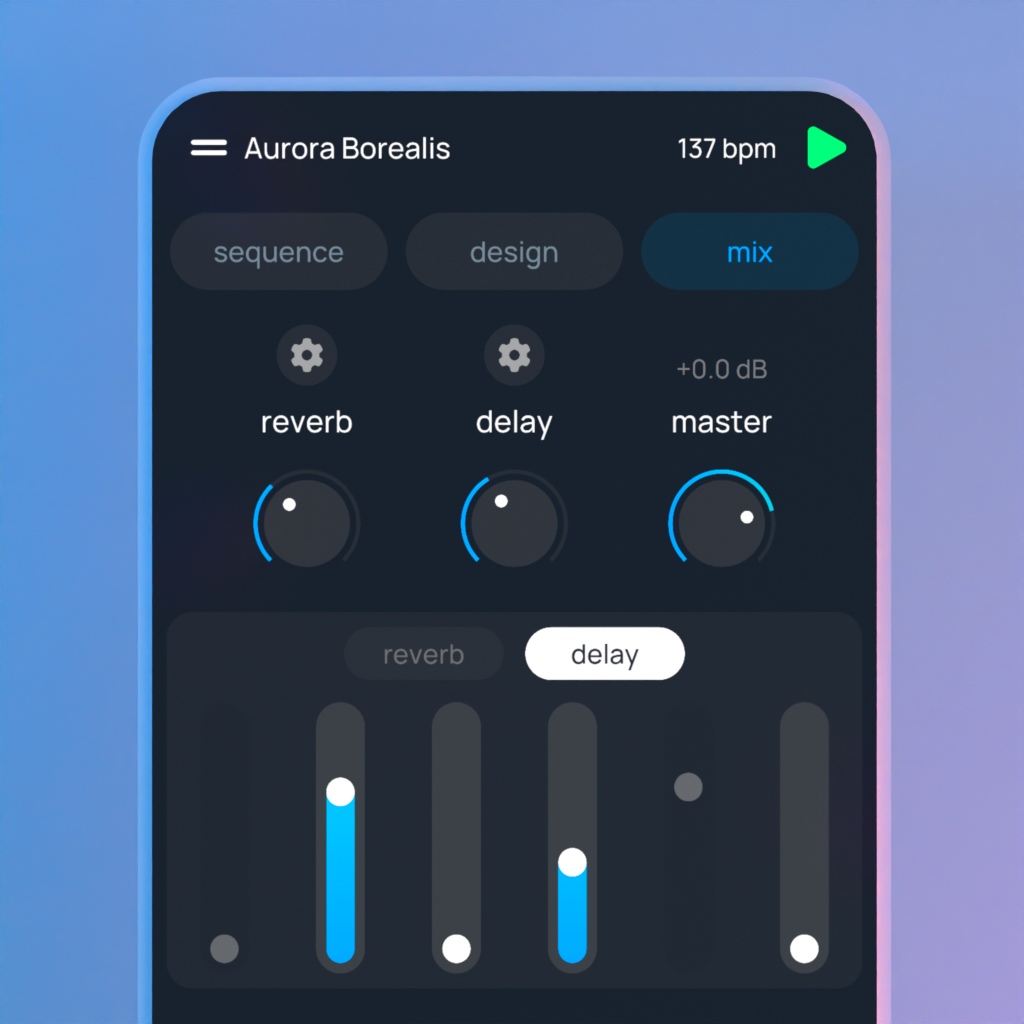
Use the reverb and delay modules to spice up the stereo image of your sound. Apply effects independently to each track to create a wider soundscape and push your sonic exploration even further.
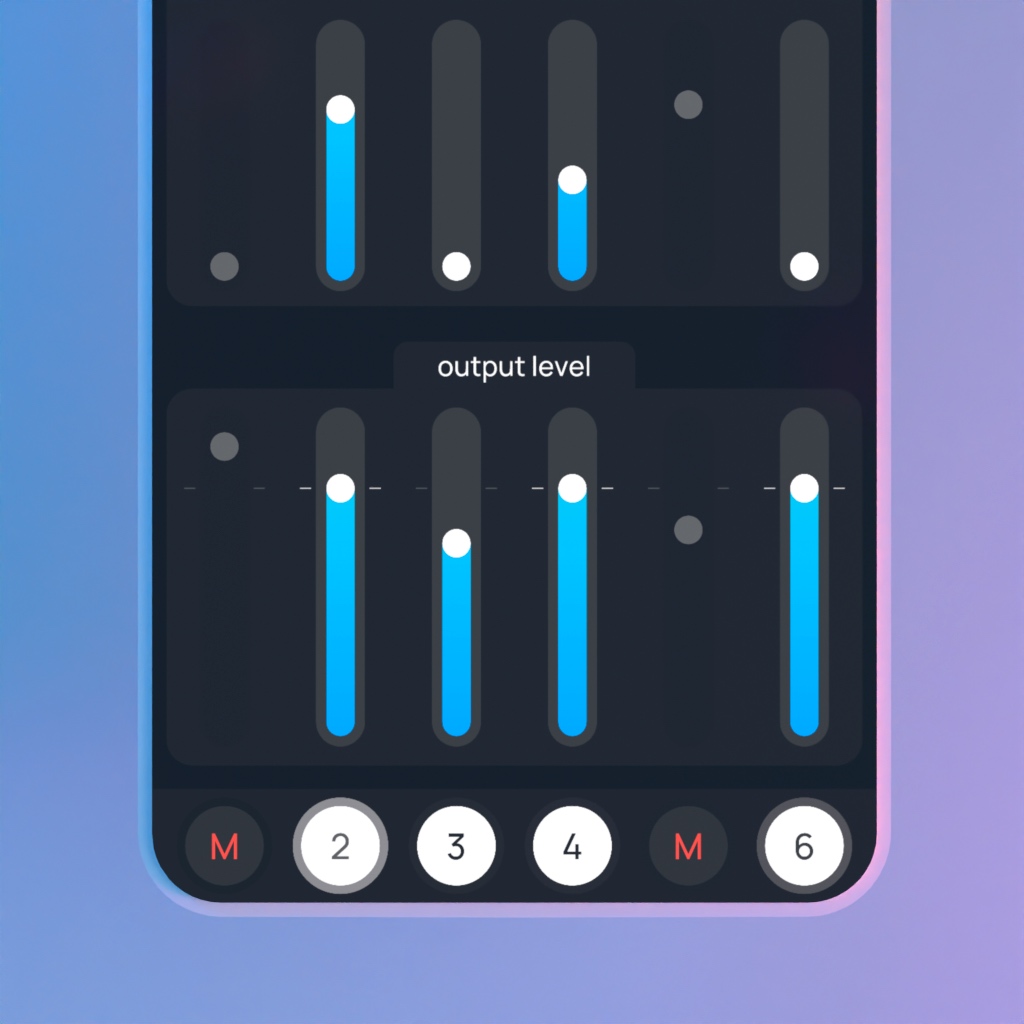
Whether you want to carefully adjust the mix between your tracks, or take advantage of the mute buttons to perform live, the virtual mixer is here for you.
Connect with other Polaris users for support and discussion. The Discord server is the spot to share community tips, report issues, and to hear first about upcoming features and releases.
 Join Discord
AUv3 plugin included in the iOS version
Part IV — The Child’s Perspective Shift to the child’s sensory world: smells, textures, and a horizon of unknowable intentions. The babysitter’s gestures are magnified—finger tracing a constellation on the ceiling, spoon pauses midair. The child senses the patterning of care as narrative: rituals that say “you are safe.” But intersperse this with moments when routine stumbles—an unfamiliar ringtone, a new scar on the babysitter’s knuckles—that create friction and introduce questions the child cannot yet name.
Part III — Versioning, Memory, and the “Final” Turn the file-name motif into a thematic engine. Unpack what “Final v0.2.2b” suggests: a promise of completion that nevertheless admits to prior drafts, minor patches, and lingering uncertainty. Contrast the human craving for a clean ending with the software-like bureaucracy of incremental fixes. Consider flashbacks—earlier babysits—rendered as earlier builds: v0.1 (first awkward attempts), v0.2 (less fear, more rules), v0.2.2b (a delicate balance of improvisation and protocol). The “Final” is less about closure than about the acceptance of an ongoing, necessary preparedness.
Part V — Small Crises, Large Consequences Build a sequence of escalating micro-incidents: a curtain catches fire for an instant and is smothered; a power cut that renders a room an inkblot of silhouettes; a neighbor’s persistent knocking. Each event exposes a different facet of the babysitter’s competence: improvisation, adherence to checklists, or the quiet collapse into improvised tenderness. Use these scenes to interrogate the ethics of caregiving: when to follow rules, when to break them, and how small choices reverberate. Babysitter -Final v0.2.2b- -T4bbo-
Title: Babysitter — Final v0.2.2b — T4bbo
Part II — The Babysitter as Caretaker and Protocol Frame the babysitter in dual terms: human caregiver and executor of rules. Sketch small daily acts—diaper changes, tucking a blanket, whispering nonsense rhymes—then tilt perspective to reveal the protocol beneath them: checklists, emergency steps, decision trees. Let moments of tenderness be punctuated by the quiet logic of contingency plans: “If fever > 38.5°C, call; if inconsolable after 20 minutes, escalate.” The effect should be subtly unsettling: affection braided with procedural rigor. Part IV — The Child’s Perspective Shift to
Part VI — The Mechanical and the Intimate Weave in subtle technological motifs—battery icons, update dialogs, a stray line of terminal text peeking from a tablet—and make them metaphors for emotional states. Let the babysitter’s hands, steady and callused, map to a cursor that blinks patiently between tasks. Treat technology neither as villain nor savior but as a mirror: a scaffold that magnifies human temperament and fallibility.
Opening (Hook) A single flicker of a neon sign outside the apartment sets the tempo: erratic, intimate, impossible to ignore. The file name—Babysitter -Final v0.2.2b- -T4bbo-—reads like a timestamp of care and revision, a talisman of iterative attention. It promises a story that balances domestic tenderness and uncanny precision, where small human vulnerabilities collide with the mechanical patience of a thing that has been debugged one too many times. Part III — Versioning, Memory, and the “Final”
Possible Closing Line “She closed the app without fanfare; the final tag glowed, not as an ending but as a ledger where tenderness and small cunning were recorded together.”
Resolution — A Version That Holds End with a quiet, open resolution that honors both care and uncertainty. The file name persists—Final v0.2.2b—now less a boast than an artifact of survival: a build that held long enough. The apartment returns to stillness; toys resume their islands of meaning. The babysitter logs the night in shorthand—notes that are part detail, part confession—and closes the app. The reader is left with the sense that caregiving is iterative: each night is a patch, every touch a small, necessary update.
Climax — The Decision That Defines Stage a decisive moment that tests both policy and heart: an ambiguous medical alert, a parent delayed beyond reasonable expectation, or an approaching stranger who knows the child’s name. The babysitter confronts a choice that cannot be fully reduced to an entry on a checklist. Describe the internal calculus—training vs. instinct—and the small physical gesture that resolves it: an unlocked door, a shared joke, a hand offered, a lullaby that reclaims the moment.